Critical safety notice
If you detect a pungent fishy or burning plastic smell originating from your electrical distribution board (DB box), immediately turn off your main breaker if it is safe to reach. Do not touch exposed copper terminals. An active burning odour indicates severe thermal runaway, degraded cable insulation, or melted terminal blocks that require emergency intervention.
If you see flames or heavy smoke, do not go near the DB box. Leave the unit and call 995.
Quick answer: what should you do?
Switch off the main switch if it is safe to reach, unplug high-wattage appliances, and do not push any tripped breaker back up. Then call an EMA Licensed Electrical Worker. A burning smell usually comes from a loose terminal, a degraded or underrated VI connector, or arcing inside an ageing breaker. If your power trips repeatedly and there is no burning smell, use our step-by-step isolation procedure to find the faulty circuit.
A burning smell coming from an electrical panel is one of the most alarming situations a homeowner or tenant can encounter in Singapore. Whether you live in a built-to-order (BTO) flat, an older HDB flat in Bukit Timah, or a modern private condominium, an overheated distribution board represents an imminent fire hazard rather than a routine trip.
1. Immediate safety checklist: what to do in the first 5 minutes
Before calling an emergency technician, perform the following preventative actions to arrest thermal damage and eliminate fire risks:
- Cut the master supply Locate the main incoming double-pole switch (usually the largest switch on the left side of the DB box) and flip it to the OFF position, if it is safe to reach.
- Isolate heavy appliances Disconnect induction cookers, ovens, air conditioners, water heaters, and laundry dryers from wall outlets.
- Check for physical discolouration Without opening the dead-front protective panel, check if the plastic casings around the MCB (Miniature Circuit Breaker) or RCCB (Residual Current Circuit Breaker) show dark yellowing, brown char marks, or smoke residue.
- Do not spray water or domestic cleaners Never use liquids to stop a buzzing sound or to cool a hot DB panel.
- Call an authorised professional Request on-site diagnostic assistance from an EMA Licensed Electrical Worker equipped with insulation resistance and thermal testing equipment.
2. Technical causes behind DB box melting & burning odours
Standard Singapore domestic power systems operate at 230V single-phase (or 400V three-phase for larger landed properties and commercial sites). Thermal melting inside consumer units typically stems from three primary failure modes:
A. Loose screw terminals & high contact resistance
Copper wiring contracts and expands slightly through daily heating and cooling cycles. Over years of thermal cycling, terminal screw connections on circuit breakers can loosen. A loose terminal reduces effective contact surface area, creating high electrical resistance (R). According to Joule's law of heating (P = I²R), as resistance climbs under heavy continuous current, localised heat spikes rapidly above 150°C, melting the PVC insulation of incoming cables.
B. Degraded or underrated VI connectors
In many Singapore residential installations, split busbar connections and multi-cable splices rely on VI connectors (insulated terminal blocks). If an uncertified connector or ageing plastic block is subjected to sustained currents exceeding its rated ampere capacity, the thermoplastic enclosure chars and emits a distinctive acrid odour resembling burning fish or bitter chemicals.
C. Phase imbalance & internal arcing
Dust accumulation, moisture infiltration from nearby riser ducts, and internal spring mechanism fatigue inside ageing MCBs can generate micro-arcing. While this micro-sparking may not consistently draw enough surge current to trip an older thermal-magnetic breaker instantly, it generates sustained heat that liquefies adjacent breaker housings.
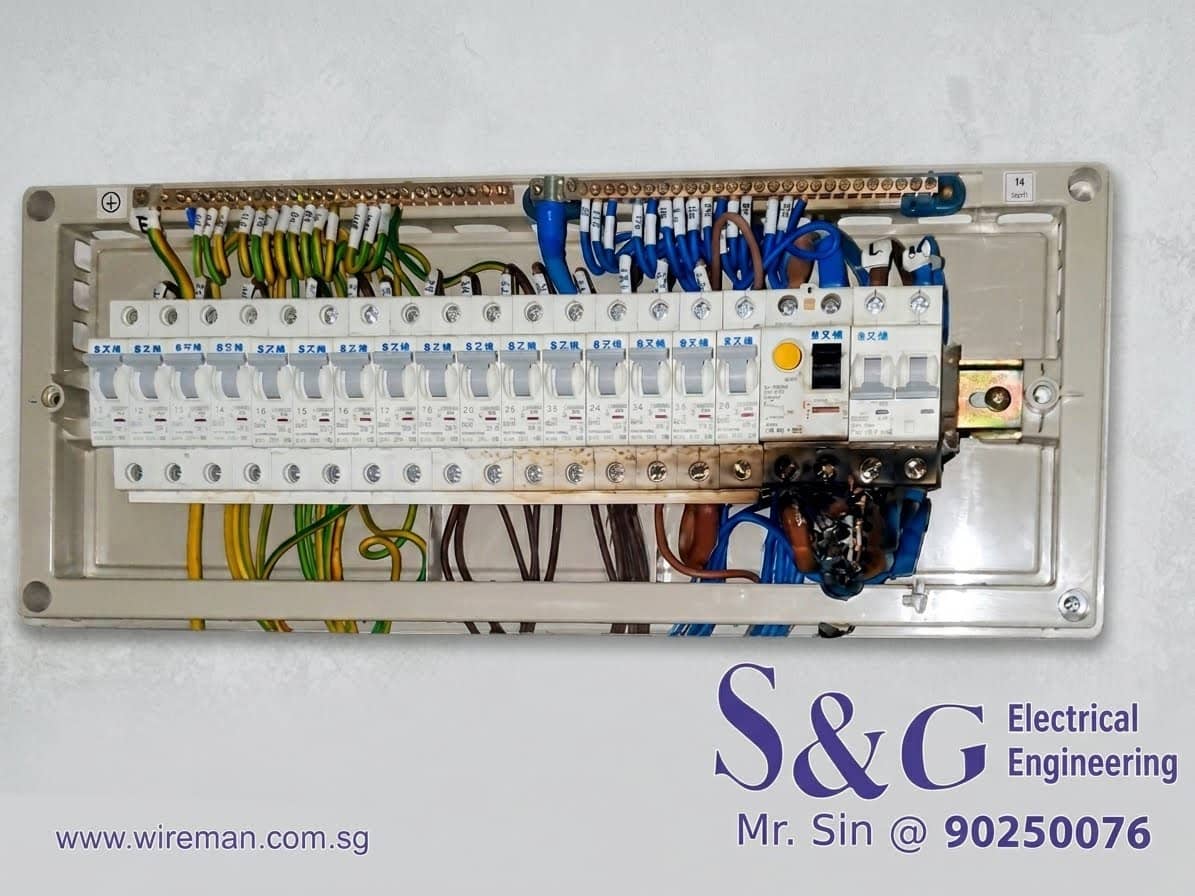
3. Field case study: emergency DB rectification at Dairy Farm Residences
Project incident: Dairy Farm Residences (condo unit), Upper Bukit Timah
Incident description: A homeowner called Wireman's 24-hour hotline at 11:45 PM after experiencing intermittent light flickering followed by a strong chemical burning odour originating from the utility closet housing the DB box.
On-site LEW assessment:
- Our EMA Licensed Electrical Worker arrived on-site within 32 minutes with calibrated testing apparatus.
- Thermal imaging revealed an operational temperature of 108.4°C localised around the 40A double-pole RCD incoming terminal.
- Removal of the protective cover revealed that an internal VI connector joining neutral conductors had suffered severe thermoplastic carbonisation due to high terminal resistance from insufficient torque during prior renovation handovers.
Emergency repair action:
- Isolated incoming power using safety lockouts.
- Excised heat-damaged cable tails and replaced oxidised copper strands.
- Installed certified high-temperature ceramic-insulated connector blocks and replaced the heat-compromised RCCB unit.
- Conducted full insulation resistance testing (500V DC megger test) complying with Singapore Standard SS 638 (Code of Practice for Electrical Installations, formerly CP 5). Normal power was safely restored by 1:10 AM.
4. Warning signs: how to spot danger before a fire occurs
Distribution boards rarely fail without prior indicators. Watch for these preliminary warnings:
- Buzzing or humming vibrations: A mild 50Hz hum is normal in large transformers, but loud buzzing or sizzling inside a consumer panel indicates loose busbars or arcing contacts.
- Breakers that refuse to reset: If an MCB trips and immediately snaps back to the middle or off position with an audible pop, do not force it upward. An active short circuit or thermal lock is preventing closure.
- Discoloured wall outlets or panel covers: Brownish yellow scorch outlines around the edges of the distribution board casing indicate extreme internal temperatures.

5. Frequently asked questions
What should I do immediately if my DB box smells like burning plastic?
Turn off the main incoming double-pole switch immediately if it is safe to reach. Unplug all high-draw appliances such as ovens and water heaters. Do not touch individual circuit breakers if they feel hot, and call an EMA Licensed Electrical Worker immediately. If you see flames or heavy smoke, leave the unit and call 995.
Why is my circuit breaker warm or hot to the touch?
While low warmth can be normal under sustained draw, high heat indicates loose connection screws, severe circuit overload, or oxidised contact terminals. High electrical resistance causes rapid thermal runaway that can ignite casing insulation.
Can I simply push the tripped breaker back up if there is a burnt odour?
Never force a circuit breaker back up if you smell burning. Doing so forces current through an active fault or melted connector, which can cause intense electrical flashovers, equipment damage, or electrical fires.