Quick answer: what does an electrician cost in Singapore?
A standard daytime attendance or call-out fee is S$40 – S$80, rising to S$100 – S$200 for emergency and after-hours visits. Power trip fault finding costs S$50 – S$200, socket replacement S$40 – S$120, circuit breaker replacement S$120 – S$400, a full distribution board upgrade S$3,000 – S$7,000, and full property rewiring S$2,500 – S$9,000. Final pricing depends on property type (landed > condominium > HDB), cable runs and how much of the existing installation must be replaced.
Navigating electrical repairs in Singapore takes both financial clarity and strict adherence to the safety standards set by the Energy Market Authority (EMA). Whether you are dealing with a sudden midnight blackout in an HDB flat or setting up a high-load commercial supply, this guide breaks down standardised market rates and the practical diagnostic workflow we use in the field.
1. Master price breakdown for electrical services in Singapore (2026)
Electrical service fees in Singapore generally comprise an attendance fee, component replacement charges, and specialised rates for work that must be carried out or endorsed by an EMA Licensed Electrical Worker (LEW). Below is the consolidated price structure across property classes.
| Service / component type | Standard rate (SGD) | Emergency / night rate (SGD) |
|---|---|---|
| Basic attendance / call-out inspection | S$40 – S$80 | S$100 – S$200 |
| Power trip diagnostics & fault locating | S$50 – S$200 | S$100 – S$200 (travel included) |
| Single / double power socket replacement | S$40 – S$120 | S$60 – S$150 |
| Light switch & fixture repair | S$40 – S$150 | S$80 – S$200 |
| Water heater / ceiling fan installation | S$80 – S$250 | S$120 – S$280 |
| Circuit breaker replacement (MCB / RCCB) | S$120 – S$400 | S$120 – S$400 |
| Distribution board (DB box) complete upgrade | S$3,000 – S$7,000 | S$3,000 – S$7,000 |
| Full property rewiring (HDB / condo / landed) | S$2,500 – S$9,000 | By inspection only |
| LEW professional endorsement | S$400 – S$800 | S$400 – S$800 |
| Renew EMA licence | S$400 – S$1,500 | S$400 – S$1,500 |
Ranges are indicative of the Singapore market and of jobs we quote. The exact figure depends on cable length, accessibility, the condition of the existing installation and the parts specified. We give an honest estimate over the phone before travelling.
Why do rates differ between HDB, condos and landed properties?
- HDB flats: standardised concealed or surface trunking layouts simplify wire pulling and cut diagnostic time, so labour hours are the lowest of the three.
- Condominiums: require management council (MCST) approval, designated work hours, and cable routes through false ceilings and risers, all of which add time on site.
- Landed properties: often run three-phase supply, outdoor weatherproof cabling and much longer cable runs, with a higher total current load to design around.
2. Commercial SP utilities account rejected: the 45 kVA rule
Short answer
If a commercial or industrial unit needs more than 45 kVA of load capacity, you cannot open the SP Group account yourself. An EMA Licensed Electrical Worker must assess the load, prepare and endorse a single-line diagram, and submit the application to SP PowerGrid on your behalf.
If you are leasing or opening a new commercial unit in Singapore, you may find that SP Group halts your account creation. Under EMA regulations, where an industrial or commercial unit requires an electricity load capacity exceeding 45 kVA:
- You cannot apply directly through the consumer portal.
- An EMA Licensed Electrical Worker (LEW) must be appointed to evaluate your equipment's total load demand.
- The LEW must draft and submit a certified Single-Line Diagram (SLD) to SP PowerGrid for technical clearance.
In practice this is the step that delays most new F&B outlets, workshops and studios: the tenancy starts, the fit-out is ready, and the power cannot be turned on because no LEW has been appointed. Budget S$400 – S$800 for the endorsement and allow time for the submission to clear.
3. Frequent DB box trips and the step-by-step isolation procedure
When the main Residual Current Circuit Breaker (RCCB) trips, power is cut across the premises to prevent an electrical fire or electrocution. Before calling an emergency electrician, you can safely narrow down the cause yourself:
- Turn off all individual MCBs Open your DB box and switch off every small miniature circuit breaker (MCB).
- Unplug every appliance Unplug all home appliances — refrigerator, microwave, computers, water dispenser — from the wall sockets.
- Reset the main RCCB Flip the main RCCB lever back to the UP (ON) position. If it holds, the incoming supply and the board itself are intact.
- Engage the MCBs one by one Switch on the individual MCBs one at a time until the main switch trips. This identifies the specific zone or room carrying the fault.
- Locate the defective appliance Re-plug the appliances in that zone one at a time. The item that trips the board immediately is your faulty device.
Safety warning: burnt connectors and ageing breakers
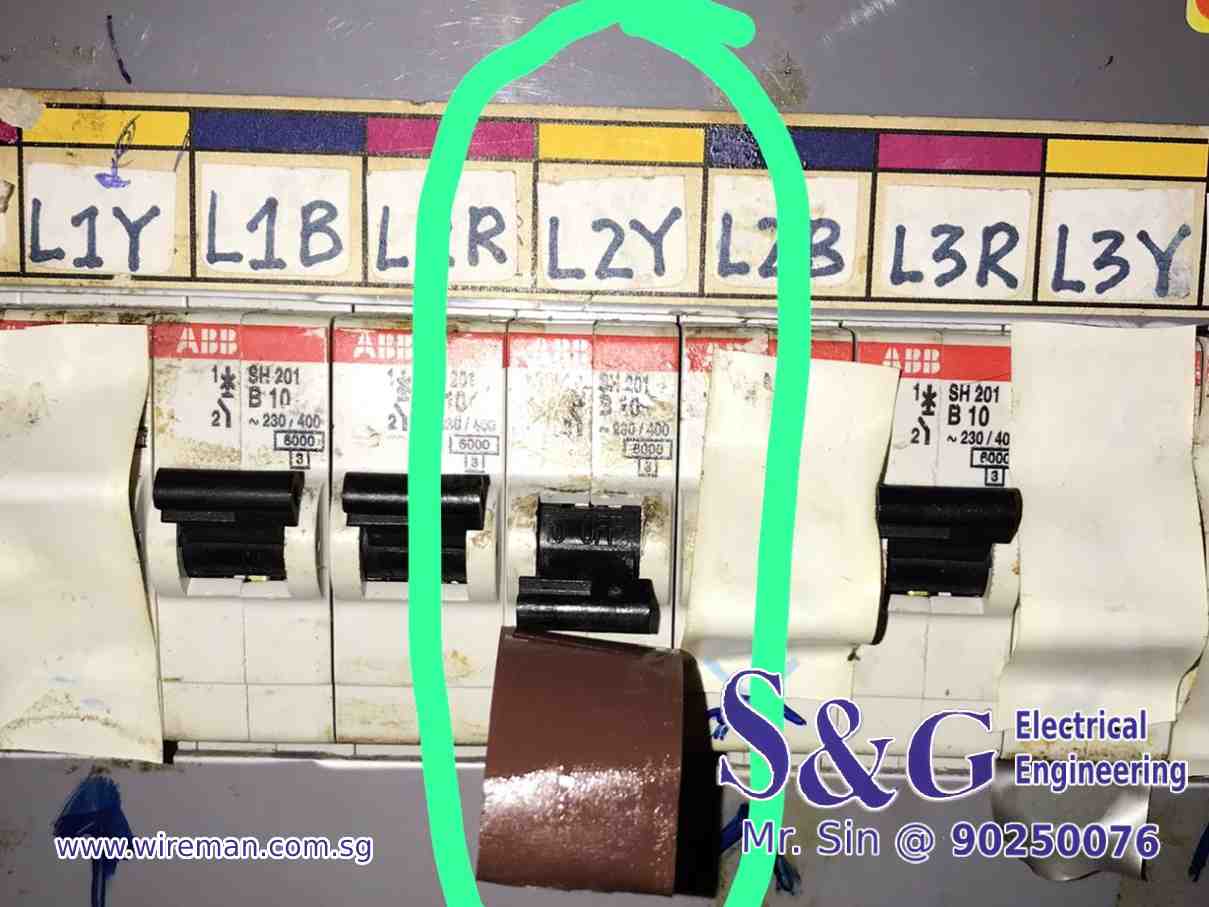
If the RCCB trips instantly even with all appliances unplugged and all MCBs switched off, you likely have damaged wiring, a shorted VI connector or a failed breaker inside the DB box. Do not force the switch up repeatedly — call an EMA licensed electrician immediately.
4. Water heater circuit trips when turned on
Water heaters draw significant continuous current, typically 3,000 W to 4,500 W. If your DB box trips specifically when the heater switch is activated, the usual root causes are:
- Heating element breakdown: mineral deposits degrade the element casing over time, letting water contact the live conductor and causing an instant earth fault.
- Melted double-pole switch connections: high resistance at loose terminals generates heat, melting the plastic housing of the 20 A heater isolator behind the wall.
- Undersized cable: legacy installations using thin 1.5 mm² wiring instead of the required 2.5 mm² or 4.0 mm² heat-resistant cable lead to thermal overload.
Expect S$40 – S$150 for an isolator switch replacement and S$80 – S$250 to install a replacement heater unit, excluding the heater itself.
5. When you legally need a Licensed Electrical Worker
Under Singapore's Electricity Act, electrical work must be carried out by a worker licensed by the EMA. Beyond changing a light bulb or resetting a breaker, these jobs should never be attempted as DIY or handed to an unlicensed handyman:
- Any work inside the distribution board, including adding, replacing or re-rating breakers.
- New circuits, sub-circuits or socket points, and any rewiring.
- Water heater and air-conditioning power points.
- Commercial or industrial installations above the prescribed load thresholds, which additionally require LEW supervision and endorsement.
- Anything needing submission to SP Group, HDB, JTC or the EMA.
There is also an insurance dimension: after an electrical fire, insurers routinely ask who carried out the installation work. Unlicensed work is a common ground for rejecting a claim.
6. How to choose an electrician without overpaying
- Ask for the licence number. A genuine LEW licence number, such as 7/81470, can be checked against EMA records.
- Get the attendance fee separately from the repair quote. The two are different charges; anyone unwilling to state the call-out fee upfront is a warning sign.
- Describe the symptom precisely on the phone. "The main RCCB trips only when the water heater is on" lets an experienced electrician give a far tighter estimate than "no power".
- Be wary of an immediate recommendation to replace the whole DB box before any testing has been done. A full upgrade is a S$3,000+ job and is not the answer to most trips.
- Check dated photo evidence and reviews of completed work in properties like yours.
Frequently asked questions
How much does an electrician cost in Singapore in 2026?
A standard daytime call-out is S$40 – S$80 and emergency attendance is S$100 – S$200. Beyond the attendance fee, common repairs run from S$40 for a socket replacement to S$400 for a circuit breaker; major works such as a DB box upgrade (S$3,000 – S$7,000) or full rewiring (S$2,500 – S$9,000) are quoted after an on-site inspection.
Why am I not allowed to create an SP account for my commercial unit?
If your commercial property's load demand exceeds 45 kVA, SP Group and EMA regulations require a Licensed Electrical Worker to inspect the installation, endorse the single-line diagram and formally submit the application on your behalf.
How do I isolate a faulty appliance causing a home power trip?
Turn off the main RCCB, unplug every appliance, reset the RCCB to ON, then switch the individual MCBs back on one at a time and re-plug appliances one by one until the board trips again. The item that causes the trip is the defective device.
Why does turning on the water heater trip the RCCB main breaker?
Because the heater is leaking current to earth. The usual causes are a degraded heating element inside the tank, an oxidised or melted double-pole switch, or cable gauge too small for the heater's load. Stop using the heater until it has been tested.
Why do electrician rates differ between HDB, condominium and landed properties?
HDB flats use standardised trunking layouts that simplify wire pulling. Condominiums require MCST approval, restricted work hours and false-ceiling cable routes. Landed properties often have three-phase supply, outdoor weatherproof cabling and higher total load. Each factor adds labour hours and materials.
Do I legally need a licensed electrician in Singapore?
Yes. Electrical work must be carried out by an EMA Licensed Electrical Worker, and installations above the prescribed load thresholds must also be supervised and endorsed by an LEW. Unlicensed work is also a common ground for an insurer to reject a claim after an electrical fire.